Artificial Intelligence is no longer a futuristic idea—it’s already here, shaping the way we build applications. From conversational assistants to intelligent search, recommendation engines, and automated content generation, AI is becoming a must-have in modern software.
But here’s the challenge: if you’re a Java or Spring Boot developer, integrating AI hasn’t been easy. Most AI SDKs are Python-first, and juggling multiple APIs can quickly become overwhelming.
That’s where Spring AI comes in. 🌟
🌱 What is Spring AI?
Spring AI is a new project from the Spring ecosystem, designed to make AI integration simple, consistent, and developer-friendly for Java applications.
Think of it as the “Spring Boot” of AI—it provides abstractions, auto-configuration, and pluggable integrations so you can focus on building features, not wrestling with SDKs.
With Spring AI, you can:
-
Connect to Large Language Models (LLMs) like OpenAI, Azure OpenAI, Hugging Face, and more.
-
Generate text, classify content, or summarize documents.
-
Work with embeddings for semantic search and recommendations.
-
Seamlessly use AI inside your existing Spring Boot microservices.
✨ Key Features
Here’s why developers are excited about Spring AI:
-
Unified API → Talk to OpenAI, Azure, or Hugging Face without rewriting your code.
-
Prompt Engineering Support → Define prompts as templates or configuration, making them reusable.
-
Embeddings API → Add semantic search or recommendation features to your apps.
-
Spring Boot Friendly → Auto-configured beans, starter dependencies, and simple properties.
-
Extensible → Switch providers with minimal changes—your code stays clean.
🛠️ Getting Started with Spring AI
Let’s build a tiny example: a REST endpoint that lets you ask questions to OpenAI.
Step 1: Add Dependency
In your pom.xml:
Step 2: Configure OpenAI API Key
In application.properties:
Step 3: Create a Controller
👉 That’s it! You now have an endpoint /ask?question=What is Spring AI? that returns an AI-powered response.
💡 Real-World Use Cases
Spring AI unlocks some powerful possibilities:
-
AI-powered Chatbots → Embed chat functionality in customer support apps.
-
Content Generation → Automate blogs, reports, or product descriptions.
-
Semantic Search → Replace keyword search with context-aware search using embeddings.
-
Recommendation Engines → Suggest products, articles, or services intelligently.
-
Data Analysis & Summarization → Quickly extract insights from long documents.
🌍 Why Does This Matter?
Java powers some of the world’s largest enterprises, yet most AI innovation has been concentrated in Python. Spring AI bridges this gap, making AI first-class in the Java ecosystem.
This means:
-
Enterprise developers don’t need to switch languages.
-
Teams can add AI features without rewriting their microservices.
-
AI becomes portable, pluggable, and enterprise-ready.
🔮 The Future of AI in Java
With Spring AI, we’re only scratching the surface. Expect deeper integrations, better tooling for prompt engineering, and production-ready features like caching, observability, and monitoring for AI calls.
As AI continues to reshape industries, Spring AI will be the go-to framework for Java developers who want to build smarter applications without leaving their favorite ecosystem.
🌈 Why Use Spring AI?
1. Familiar Developer Experience
Java developers already love the Spring ecosystem. Spring AI lets you build intelligent apps without context switching to Python or JavaScript-based AI frameworks.
2. Enterprise-Ready
Security, scalability, and observability — Spring AI is built with enterprise concerns in mind. Integrate AI where it matters most: in your existing microservices and business workflows.
3. Declarative Prompt Engineering
Write reusable prompts just like you write SQL queries or JPA repositories.
Call it from Java:
✨ Sample Use Case: AI Chatbot with Spring Boot
Let’s say you want to build a chatbot that interacts with users using OpenAI’s GPT-4 API.
This code is elegant, type-safe, and production-friendly — exactly what you'd expect from Spring.
🌍 Real-World Applications
Spring AI unlocks new possibilities in Java apps:
-
💬 Customer Support Chatbots
-
🧾 Intelligent Document Summarization
-
🔍 Semantic Search Engines
-
🧠 Knowledge Base Assistants
-
🛠 Code Generation Tools
-
📚 AI Tutors and Content Creators
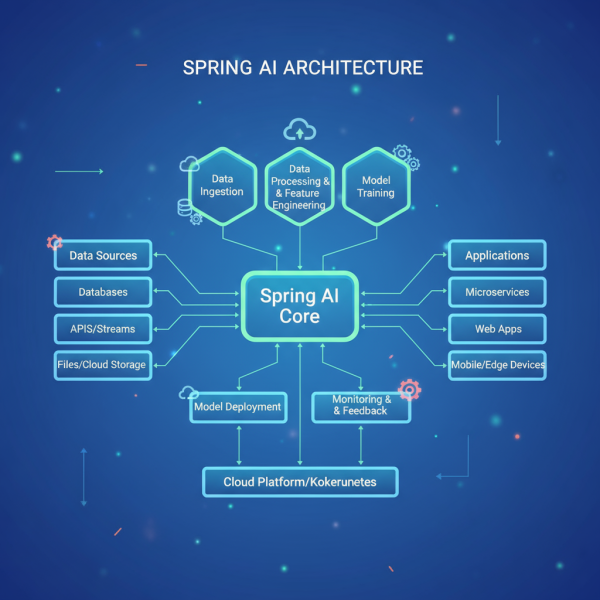
🧬 Architectural Diagram (Conceptual)
🧩 Extensibility
Spring AI is designed with pluggable components, meaning you can:
-
Plug in your own LLM provider
-
Implement a custom VectorStore
-
Replace the Retriever logic
-
Use your own Prompt rendering engine, if needed
It follows the same Strategy Pattern + Dependency Injection approach that Spring devs are used to.
🔒 Security & Observability
Because Spring AI is built on Spring Boot:
-
You can use Actuator for monitoring AI endpoints
-
Apply Rate Limiting / Circuit Breakers via Spring Cloud
-
Secure API keys via Vault, AWS Secrets Manager, or Spring Config Server
-
✅ Conclusion
Spring AI is more than just another library—it’s a bridge between enterprise-grade Java and the fast-evolving world of AI and LLMs.
If you’re already working with Spring Boot, integrating AI is now as simple as adding a dependency and writing a few lines of code.
🚀 So why wait? Start experimenting with Spring AI today and bring the power of artificial intelligence into your Java applications!