
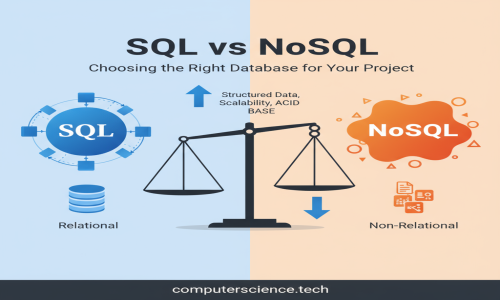
In today's data-driven world, choosing the right database is a critical decision that can significantly impact the performance, scalability, and maintainability of your application. Two major types of databases dominate the landscape: SQL (Structured Query Language) and NoSQL (Not Only SQL) databases. But how do they differ, and more importantly, when should you use one over the other?
This blog will explore the key differences between SQL and NoSQL databases, real-world examples of when to use each, and criteria to help you make an informed decision for your next project.
🔍 What is SQL?
SQL databases are relational databases that store data in structured tables with rows and columns. They use a predefined schema and are accessed using Structured Query Language (SQL).
Popular SQL Databases:
-
MySQL
-
PostgreSQL
-
Microsoft SQL Server
-
Oracle
🔍 What is NoSQL?
NoSQL databases are non-relational or distributed databases. They store data in formats like key-value pairs, documents, wide-columns, or graphs. They’re more flexible, scalable, and ideal for handling unstructured or rapidly changing data.
Types of NoSQL Databases:
-
Document-based: MongoDB, CouchDB
-
Key-Value: Redis, DynamoDB
-
Column-family: Apache Cassandra, HBase
-
Graph-based: Neo4j, ArangoDB
⚖️ Key Differences: SQL vs NoSQL
| Feature | SQL | NoSQL |
|---|---|---|
| Data Model | Relational (tables with fixed schema) | Non-relational (JSON, key-value, etc.) |
| Schema | Fixed and predefined | Dynamic and flexible |
| Scalability | Vertical (scale-up) | Horizontal (scale-out) |
| Query Language | SQL | Varies (MongoDB uses BSON, Redis CLI, etc.) |
| Transactions | Strong ACID compliance | BASE model (eventual consistency) |
| Best Use Case | Structured data, complex queries | Unstructured/rapidly changing data, big data |
| Examples | Banking systems, ERPs, CRMs | Real-time apps, IoT, analytics platforms |
🌍 Real-World Use Cases
✅ When to Use SQL:
-
Banking & Financial Systems
-
Use Case: Transaction-heavy applications where consistency and integrity are crucial.
-
Example: A core banking system using PostgreSQL to ensure accurate ledgers and audit trails.
-
-
Customer Relationship Management (CRM) Tools
-
Use Case: Structured, relational data such as customer profiles, sales leads, and interaction history.
-
Example: A CRM platform using MySQL with normalized tables for efficient querying.
-
-
E-commerce Product Catalog
-
Use Case: Complex filtering, sorting, and transactional support.
-
Example: A multi-vendor e-commerce site storing product SKUs, inventory, and order history in SQL Server.
-
✅ When to Use NoSQL:
-
Real-Time Analytics & Big Data
-
Use Case: Processing massive volumes of semi-structured or unstructured data.
-
Example: A data pipeline using Apache Cassandra for storing real-time metrics across thousands of nodes.
-
-
Content Management Systems (CMS)
-
Use Case: Flexibility in content types and fields that evolve over time.
-
Example: A headless CMS using MongoDB to store blog posts, videos, and user comments.
-
-
IoT & Sensor Data
-
Use Case: High-ingestion rates, flexible schema.
-
Example: A fleet management system using Amazon DynamoDB for time-series data from GPS trackers.
-
-
Social Networks
-
Use Case: Handling relationships between users (friends, followers).
-
Example: A social graph stored in Neo4j for fast traversal of user connections.
-
🧠 How to Choose: Criteria for Database Selection
| Criteria | SQL | NoSQL |
|---|---|---|
| Data Structure | Well-structured, relational | Dynamic, evolving, or hierarchical |
| Data Integrity | High importance (ACID transactions) | Eventual consistency acceptable |
| Scalability Needs | Scale-up (vertical) | Scale-out (horizontal, distributed) |
| Performance | Complex queries, joins | High-speed reads/writes, distributed processing |
| Development Speed | Slower (due to rigid schema) | Faster prototyping (schema-less) |
| Use Case Domain | Finance, ERP, Legacy systems | IoT, Real-time apps, Web apps, Analytics |
| Support & Maturity | Mature with long-term support | Rapidly evolving, some tools are still maturing |
🎯 Conclusion: SQL or NoSQL — Which One Should You Use?
There is no one-size-fits-all answer. The best choice depends on your specific project requirements:
-
Use SQL if your data is highly structured, relationships are important, and you need strong consistency (e.g., financial apps, enterprise systems).
-
Use NoSQL if you deal with unstructured or rapidly changing data, need high scalability, and want faster development cycles (e.g., mobile apps, social platforms, big data analytics).
In some modern architectures, companies use both SQL and NoSQL databases together (polyglot persistence), selecting the best tool for each microservice or component.
🛠️ Pro Tip:
"Don’t pick a database because it’s trendy—pick it because it solves your problem."