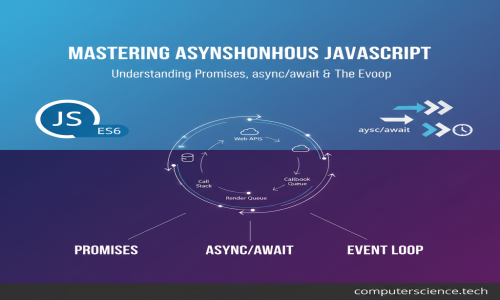

The JavaScript landscape has evolved drastically over the past decade. What started as a simple scripting language for browsers has now become the backbone of modern web development — powering everything from interactive UIs to serverless apps and complex APIs.
A huge leap in this journey was ECMAScript 6 (ES6) and the features that followed in ES7, ES8... up to ES2024 — collectively referred to as ES6+.
This blog will walk you through the most important ES6+ features, showing how they can help you write cleaner, faster, and more maintainable code.
🔹 1. let and const — Say Goodbye to var
✅ Why use them?
-
let: Block-scoped variable, can be updated -
const: Block-scoped constant, cannot be reassigned -
var: Function-scoped and hoisted — can lead to bugs
💡 Example:
🔹 2. Arrow Functions ()=>{} — Shorter, Smarter Functions
✅ Why use them?
-
Cleaner syntax
-
Lexical
this— no need to.bind(this) -
Great for one-liners and callbacks
💡 Example:
🔹 3. Template Literals `...` — Dynamic Strings Made Easy
✅ Why use them?
-
Multi-line strings
-
Embed expressions using
${} -
Much more readable than
+concatenation
💡 Example:
🔹 4. Destructuring — Unpack Like a Pro
✅ Why use it?
-
Extract values from objects or arrays in one line
-
Improves readability, especially with complex data
💡 Example (Object):
💡 Example (Array):
🔹 5. Spread (...) and Rest (...) Operators
✅ Why use them?
-
Spread: To copy or merge arrays/objects
-
Rest: To gather remaining elements/args
💡 Spread Example:
💡 Rest Example:
🔹 6. Default Parameters — No More x = x || 5
✅ Why use it?
-
Set default values directly in function parameters
-
Cleaner, safer function declarations
💡 Example:
🔹 7. Object Property Shorthand
When your variable names and object keys are the same, shorten your syntax:
💡 Example:
🔹 8. Enhanced Object Literals
Define methods and computed property names more elegantly.
💡 Example:
🔹 9. Modules (import/export) — Organize Like a Pro
JS modules are supported natively now — no more global scope mess.
💡 Example:
🔹 10. Optional Chaining (?.) & Nullish Coalescing (??)
✅ Why use it?
-
Avoid errors when accessing deeply nested properties
-
Provide safe fallbacks
💡 Example:
🔹 11. Promises and async/await
Modern async flow with clean syntax.
💡 Example:
🔹 12. Array & Object Utility Methods
ES6+ added powerful methods like:
-
Array.includes() -
Array.flat() -
Object.entries() -
Object.fromEntries() -
Object.values() -
Object.hasOwn()
🎯 Why ES6+ Matters in 2025 and Beyond
Modern frameworks (React, Vue, Next.js), tooling (Webpack, Vite), and even browsers are fully optimized for ES6+. If you want to:
✅ Write cleaner, maintainable code
✅ Improve performance
✅ Be interview-ready
✅ Work with modern tools & teams
Then mastering ES6+ features is non-negotiable.
✅ Final Thoughts
JavaScript is no longer the chaotic scripting language it once was. Thanks to ES6+, it’s now a powerful, elegant, and highly productive language.
So go ahead — embrace arrow functions, master destructuring, and make your code the cleanest on the block. 💪