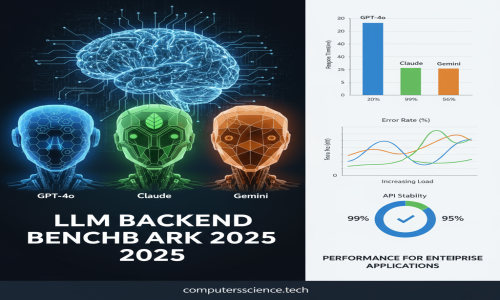
In 2025, Large Language Models (LLMs) like GPT-4o, Claude, and Gemini have become powerful tools for backend engineers. Whether you're building AI-driven APIs, automating documentation, processing large codebases, or handling natural language queries, choosing the right LLM for your backend matters a lot.
In this post, we compare the top 3 LLMs for backend developers based on:
-
⚡ Speed & response time
-
💾 Context handling
-
💰 Cost efficiency
-
🧠 Code and reasoning quality
-
🔁 Throughput for batch jobs
-
🖼️ Multimodal capabilities (images, video, etc.)
✅ Key Benchmark Criteria
| Benchmark | Why It Matters for Backend Systems |
|---|---|
| Latency / Response Time | Impacts UX and synchronous API speed |
| Throughput (Tokens/sec) | Crucial for batch processing & high-load systems |
| Context Window | Determines how large an input the model can handle |
| Token Cost (Input & Output) | Affects scalability and operational budget |
| Output Quality | Impacts accuracy for code, summaries, queries |
| Modality Support | Needed for image/video understanding tasks |
🧪 GPT‑4o vs Claude vs Gemini – 2025 Comparison
| Model | Context Handling | Response Time | Cost | Strengths |
|---|---|---|---|---|
| GPT‑4o (OpenAI) | Up to ~128K tokens, solid at mid/short inputs | Fast for general tasks, may slow on complex inputs | Higher than average for premium usage | Balanced for code, reasoning, and multimodal inputs |
| Claude (Anthropic) | Handles very long contexts (~200K tokens) extremely well | Slightly slower in deep reasoning but very accurate | Premium pricing for high-quality outputs | Excellent at code quality, logic-heavy tasks |
| Gemini (Google) | Extremely large context (in Pro & Flash versions) | Gemini Flash is very fast; good for bulk tasks | Competitive pricing; cost-effective at scale | Great for multimodal inputs and document processing |
🛠️ Use Case Breakdown
| Use Case | Best Model | Why |
|---|---|---|
| Fast, real-time API suggestions | GPT‑4o, Gemini Flash | Lower latency, optimal for small inputs |
| Long document or code analysis | Claude, Gemini | Excellent context retention |
| Code generation or debugging | Claude, GPT‑4o | Higher accuracy and structured output |
| Processing images or multimodal input | Gemini, GPT‑4o (Vision) | Native support for images, video |
| Bulk processing, high-volume tasks | Gemini Flash | High throughput, lower cost |
| Cost-sensitive operations | Gemini, selective Claude use | Best trade-off between cost and performance |
🧑💻 How to Benchmark for Your Project
Here's a step-by-step approach to benchmark models in your backend:
-
Define input size — How many tokens do your inputs typically use?
-
Measure latency — Time to first token and full response.
-
Check throughput — Measure processing speed for batches.
-
Review output quality — Look at accuracy, hallucinations, and completeness.
-
Calculate total cost — Include both input + output token cost.
-
Simulate edge cases — Huge inputs, bad data, broken prompts.
-
Monitor in production — Analyze logs, latency trends, and cost over time.
⚖️ Summary Recommendations
| Scenario | Best LLM |
|---|---|
| Need speed + low latency | Gemini Flash, GPT‑4o |
| Processing massive documents | Claude, Gemini |
| Code-first applications | Claude, GPT‑4o |
| Working with images/media | Gemini, GPT‑4o Vision |
| Cost-conscious scaling | Gemini, selectively Claude or GPT-4-turbo |
💡 Final Thoughts
Choosing the right LLM isn’t about who’s the smartest — it’s about what fits your backend use case.
-
Use Claude when quality and reasoning matter.
-
Use Gemini when you want speed and cost-efficiency for large-scale tasks.
-
Use GPT‑4o when you need a reliable all-rounder with great support and tooling.
Most teams will benefit from using multiple LLMs depending on the context:
-
Quick responses → Gemini Flash
-
Complex logic → Claude
-
Multimodal tasks → GPT-4o Vision