
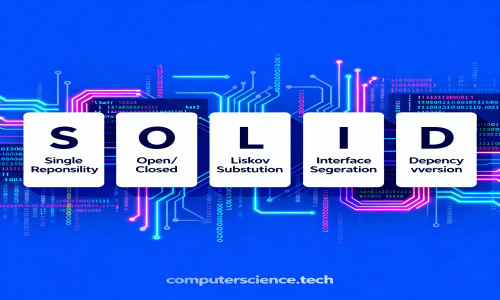
In the world of software engineering, writing code that works is only half the journey. The real challenge lies in writing code that is clean, maintainable, and scalable. This is where the SOLID principles come in.
Introduced by Robert C. Martin (Uncle Bob), the SOLID principles are five golden rules of object-oriented programming that help developers build flexible systems that can grow without turning into unmaintainable spaghetti code.
Let’s explore each principle with examples and simple visuals.
S – Single Responsibility Principle (SRP)
“A class should have only one reason to change.”
📌 Visual Representation:
O – Open/Closed Principle (OCP)
“Open for extension, but closed for modification.”
📌 Visual Representation:
L – Liskov Substitution Principle (LSP)
“Subtypes must be substitutable for their base types.”
📌 Visual Representation:
I – Interface Segregation Principle (ISP)
“No client should be forced to depend on methods it does not use.”
📌 Visual Representation:
D – Dependency Inversion Principle (DIP)
“High-level modules should not depend on low-level modules. Both should depend on abstractions.”
📌 Visual Representation:
🌟 Why SOLID Matters
By following SOLID principles, you:
-
Reduce code duplication.
-
Improve testability.
-
Make your software easier to scale.
-
Avoid technical debt in the long run.
As projects grow, these principles act as a guiding compass, ensuring your codebase remains robust, adaptable, and future-proof.
✨ Final Thought:
Mastering SOLID isn’t just about memorizing definitions—it’s about developing a mindset of writing clean, purposeful, and elegant code. Apply these principles consistently, and your software will thank you years down the road.